Flagship case study
JTNY Law: the proving environment.
JTNY Law is where the Legal Growth Operating System is built and operated against a real firm's intake volume and constraints. This case study separates what is shipped and verified today from what is on the integration roadmap—because that distinction is the whole point of defensible proof.
1 — Starting environment
A familiar setup for a consumer law firm.
JTNY began where most firms are: a website the firm did not fully control, content produced without a governing architecture, analytics that stopped at sessions and form counts, and no reliable way to connect a signed matter back to the search that started it.
2 — Structural constraints
- Platform ownership: the firm could not independently deploy, migrate, or audit its own website
- Content overlap: pages competing with each other for the same queries, with no topic ownership
- Attribution gap: calls and forms not reliably tied to source, page, or campaign
- Intake blindness: no measured path from inquiry to consultation to retention
3, 4 & 5 — The architecture Wolfe built
Infrastructure, governance, and instrumentation.
Platform architecture
A ground-up Astro/Cloudflare rebuild: static-first delivery, firm-owned repository and deployment pipeline, structured data, and an information architecture designed around legal decision journeys rather than a vendor's CMS template.
Content intelligence & governance
The content corpus was audited, mapped to owned topics, and placed under governance: cannibalization controls, internal-link architecture, and an editorial operating system that decides what gets expanded, consolidated, or retired.
Attribution & intake instrumentation
First-party event capture ties calls and forms to source, landing page, campaign, and session—the records the closed loop will be built on, owned by the firm rather than a call-tracking vendor.
6 & 7 — Proven today vs. the roadmap
What is shipped, and what is not yet.
Capabilities below are stated as capabilities. Measured business outcomes will be published only with dates, denominators, and JTNY's written approval, as our proof rules require.
Shipped and operating
- Owned Astro/Cloudflare website architecture with firm-controlled repository and deployment pipeline
- Technical SEO, information architecture, and structured data across the corpus
- Content corpus under governance: topic ownership, cannibalization controls, and an editorial operating system
- Conversion architecture for calls and forms on priority practice paths
- First-party event and lead attribution instrumentation (source, page, campaign, session)
- Website lead delivery into Docket’s live intake inbox with source attached — the AstroPress bridge
- Intake workflow in Docket: response SLAs, contact-attempt logging, and attorney approval routing
- Search Console and analytics instrumentation with an operating review cadence
Closed-loop roadmap — planned, not yet live
- Search-to-signed-matter attribution and cohort reporting
- Qualification, consultation, follow-up, and retention reporting by stage
- Rejection and referral reason taxonomy
- Closed-loop recommendations feeding content and operating decisions
The measured technical record
Some outcomes are already on the record.
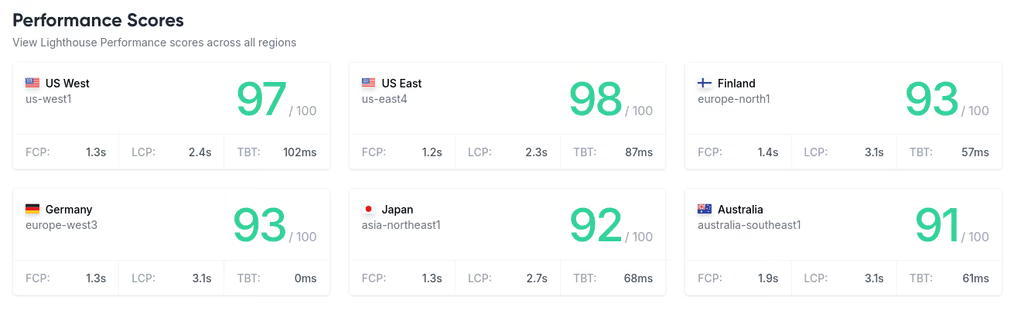
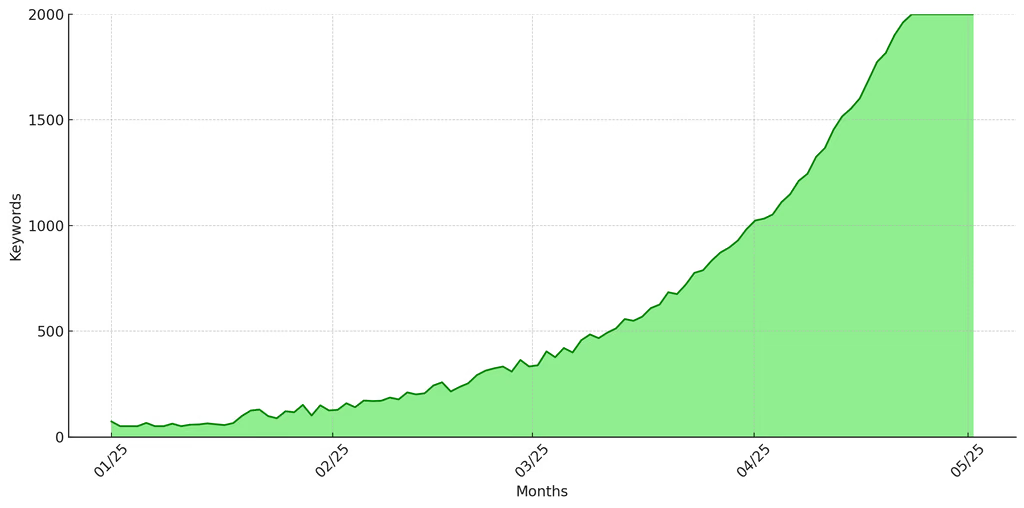
The technical layer is measured continuously, and the before/after outputs are published. Lighthouse performance moved from the 40s to the 90s across six regions, the keyword footprint grew from roughly 60 to 2,000+ in five months, and engagement time quadrupled—unretouched screenshots, captured 2025.
8 — What the client owns
Everything. That's the model.
If the engagement ended tomorrow, JTNY would keep a complete, operable growth system. That portability is not a concession—it is the product working as designed.
Request an Architecture Review- The source repository and deployment pipeline
- The full content corpus, structured data, and media
- All first-party lead and attribution records
- Documented workflows and integration inventory