Law firm website design · owned platform engineering
Law firm web design, rebuilt as infrastructure.
A new look is temporary. The platform underneath should be fast, portable, measurable, and owned by the firm. Wolfe builds law firm websites on Astro and Cloudflare with technical SEO, conversion architecture, and first-party attribution designed in from the start.
astro · cloudflare · static-first rendering · firm-owned repository · first-party attribution
What the website has to do
A law firm website is the front door to a larger operating system.
01
Help the right visitor recognize the right firm.
Practice, jurisdiction, urgency, and case fit have to be clear before visual polish matters. The information architecture should mirror the legal decisions a prospective client is trying to make.
02
Earn visibility without fighting the platform.
Fast rendering, clean URLs, structured data, controlled templates, internal links, and governed publishing give search strategy a stable surface to compound on.
03
Convert attention without losing context.
Calls and forms should preserve the page, source, campaign, and first-party session that created the inquiry so intake receives more than a name and phone number.
04
Remain operable when vendors change.
The firm should control the domain, repository, content, deployment, analytics, and documentation. A website is not owned if leaving the vendor means rebuilding it again.
Owned vs. rented
If changing vendors requires another rebuild, the firm never owned the site.
Ownership is an operational fact, not a sentence in a proposal. The firm needs control of the assets, credentials, records, and deployment path required to keep the website running without the incumbent.
- 01 Domain and DNS
- Registered and controlled by the firm, with documented administrative access
- 02 Source code
- Stored in a firm-owned repository with version history and deployment access
- 03 Content and media
- Portable files and structured records—not trapped in a proprietary export
- 04 Hosting and deployment
- Transparent Cloudflare configuration and a documented build pipeline
- 05 Analytics and lead data
- First-party records and firm-controlled analytics, Search Console, and call-tracking access
- 06 Operating documentation
- Architecture, redirect, integration, publishing, and handoff records maintained with the system
Astro and Cloudflare
Built this decade—not patched into the next one.
WordPress can serve many organizations well. Wolfe chose a different architecture for growth-critical law firm sites: static-first rendering, edge delivery, repository ownership, and deployment controls without a page-builder and plugin chain defining the performance ceiling.
Static-first rendering
Pages are produced ahead of the request whenever possible instead of assembled through a database and plugin chain on every visit. The result is a smaller runtime surface and a more predictable performance budget.
Cloudflare edge delivery
Built assets are served close to the visitor through Cloudflare. Caching, redirects, headers, and deployment behavior are treated as part of the application—not left as hosting-panel folklore.
Repository-based ownership
Templates, components, content integrations, and configuration are versioned as code. The firm can audit what changed, restore prior behavior, and transfer operation without reconstructing the site from screenshots.
Deployment controls
Build checks can validate routes, types, schema, links, and performance expectations before a change reaches production. Technical standards become release conditions instead of annual recommendations.
Measured platform output
Design quality includes what the visitor does not see.
The platform should be measured across routes and regions, then held to a performance budget as the site evolves. This is a real output from the proving environment after its platform rebuild—not a template benchmark.
See the documented technical SEO record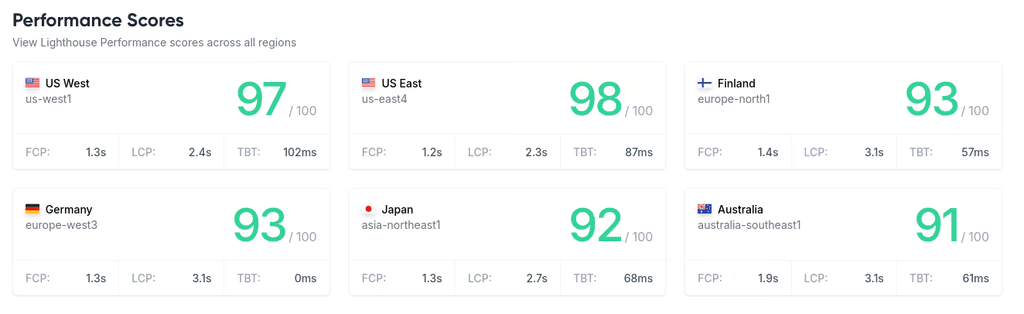
Conversion and attribution
The page should arrive in intake with the lead.
A conversion rate without source quality or intake disposition can reward the wrong behavior. Wolfe designs the website and measurement record together, then connects the intake and matter stages through the Legal Growth OS.
- 01 Decision path
- Priority pages answer the visitor’s immediate legal situation, establish jurisdiction and fit, and offer a clear next step without forcing a generic site tour.
- 02 Calls and forms
- Contact options are designed around urgency and device context, then tested as production workflows rather than treated as decorative components.
- 03 Attribution record
- Source, landing page, campaign, referrer, and first-party session context are captured with the inquiry when available and appropriate.
- 04 Intake handoff
- The lead arrives with enough context for the intake team to respond, qualify, and record the disposition without rebuilding the marketing history by hand.
- 05 Matter feedback
- With the integrated Legal Growth OS, downstream qualification and retention outcomes can inform which pages, markets, and matter types deserve further investment.
Rebuild and migration
Preserve the equity. Replace the constraint.
A redesign should not erase the URLs, content, links, measurement history, or operational knowledge the firm has already paid to create. Migration is an architecture workstream, not a launch-day checklist.
-
stage 01
Control and baseline
Inventory the domain, DNS, hosting, CMS, repository, analytics, Search Console, call tracking, forms, integrations, current rankings, and performance before changing the platform.
-
stage 02
Corpus and redirect map
Decide which URLs remain, consolidate overlapping content, preserve valuable paths, and map every retired URL to a relevant destination before launch.
-
stage 03
Architecture and design system
Build the information model, reusable components, legal decision paths, structured data, conversion patterns, and measurement plan as one system.
-
stage 04
Content migration and instrumentation
Move approved content into governed templates, implement analytics and lead attribution, and verify call/form delivery into the firm’s operating workflow.
-
stage 05
Acceptance and controlled launch
Test redirects, routes, metadata, schema, accessibility, responsive behavior, forms, analytics, permissions, and rollback procedures before switching production traffic.
Not a commodity redesign
The website ships inside an operating engagement.
Wolfe does not hand over a launch and disappear. The website is the owned platform inside the Wolfe Growth Platform: search, content, conversion, attribution, engineering, and ongoing operation under one governance model.
Engagements begin at $20,000/month.
Where the brief expands
A new site may not be the first constraint to fix.
If the firm cannot identify account ownership, preserve its lead sources, define a qualified matter, or respond consistently, a visual redesign alone will not repair growth. The Architecture Review establishes the sequence before implementation begins.
Comparing a broader provider relationship? Read Wolfe’s position on the law firm marketing agency model.
Buying questions
What to settle before commissioning a law firm website.
Q01
How much does law firm web design cost?
Cost depends on whether the firm needs a visual reskin or a platform rebuild, the size and condition of the content corpus, migration and redirect risk, required integrations, accessibility and compliance work, and the ongoing operating scope. Compare what the firm owns at completion, not only the launch price. Wolfe website work is delivered inside engagements beginning at $20,000/month.
Q02
How long does a law firm website redesign take?
A responsible timeline follows the migration risk. A small, controlled corpus can move faster than a multi-market site with years of overlapping pages, undocumented forms, and vendor-controlled accounts. The schedule should identify access, content decisions, design approval, integration testing, redirect QA, and launch acceptance rather than promise a date before those dependencies are known.
Q03
Does a law firm need to use WordPress?
No. WordPress can be appropriate when its editorial ecosystem and available support match the firm’s needs. Wolfe uses Astro and Cloudflare because a static-first, repository-owned architecture gives us direct control over performance, templates, deployments, and portability without relying on a growing chain of themes and plugins.
Q04
Will redesigning a law firm website hurt SEO?
Any migration can create search risk if valuable URLs, content, internal links, schema, canonicals, or analytics are changed without a record. A redesign should begin with a crawl and baseline, keep a page-level redirect map, preserve useful content and intent, and monitor the launch. Design is not a reason to discard accumulated search equity.
Q05
Who should own a law firm website?
The firm should control the domain, DNS, source code or CMS, content, media, hosting or deployment account, analytics, Search Console, call-tracking numbers, form data, and documentation. Vendors can operate those assets under role-based access. Ownership should not depend on continuing the retainer.
Q06
What makes a law firm website convert?
Conversion begins with fit and clarity: the visitor recognizes the legal problem, jurisdiction, and next step; the page establishes credible reasons to act; calls and forms work in the visitor’s context; and intake responds with the original source and page attached. A button color cannot compensate for a broken decision path or a slow follow-up process.
Before the redesign
Find out what the new platform has to preserve—and what it has to replace.
The paid Architecture Review maps ownership, technical debt, search and content architecture, conversion, attribution, vendors, and intake before Wolfe writes the implementation blueprint.